You're all caught up—no notifications available.
Explore All Exams at KGS


All Exams
Explore All Exams at KGS

Khan Sir Courses
Geography I Polity I History | World Map I Indian Map I Economics I Biology

UPSC & State PSC
UPSC I BPSC I UP-PSC I MP-PSC

State Exams
UP I Bihar I MP | Rajasthan

NEET | JEE | CUET
NEET | JEE | CUET

Defence Exams
NDA I CDS I CAPF I AFCAT I SSB I Agniveer

Police Exams
UP SI | Bihar SI | Delhi Police | UP Constable

SSC Exams
CGL I CPO I CHSL I MTS I SSC GD I Delhi Police

Foundation Courses
Physics I Chemistry I Biology I History I Geography I Polity I NCERT I Math I English | Map I Reasoning

Railway Exams
RRB | RPF

Teaching Exams
TET | Teaching | UGC

Banking Exams
SBI | RBI | IBPS

Engineering Exams
Civil | Electrical | Mechanical
UGC NET
UGC NET/JRF
Current Affairs provides you with the best compilation of the Daily Current Affairs taking place across the globe: National, International, Sports, Science and Technology, Banking, Economy, Agreement, Appointments, Ranks, and Report and General Studies

SYLLABUS
GS-3: Conservation, Environmental Pollution and Degradation.
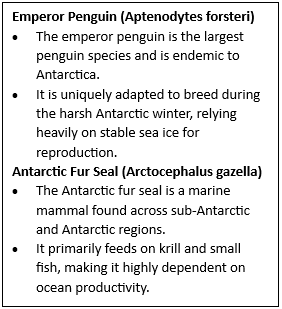
Context: The latest update of the International Union for Conservation of Nature (IUCN) Red List has uplisted Emperor penguin (Aptenodytes forsteri) and Antarctic fur seal (Arctocephalus gazella) to the Endangered category.
More on the News
• This reclassification marks a significant departure from their earlier conservation status and reflects the rapidly intensifying impacts of climate change in Antarctica.
• Antarctica has lost ice cover equivalent to ten times Los Angeles's area over three decades, accelerating ecosystem disruptions.
Key Highlights of Red List Update
• The emperor penguin has been upgraded from Near Threatened to Endangered, with projections indicating that its population could decline by nearly half by the end of the century under current warming trends.
• The Antarctic fur seal, which had earlier recovered from historical overexploitation, has now been moved from Least Concern to Endangered due to a steep population decline in recent decades.
• The Red List assessment underscores that climate change, rather than direct human exploitation, has emerged as the primary driver of species decline in Antarctica.
• Both species are now regarded as sentinel species, meaning that their declining populations serve as early indicators of broader ecological disruptions.
Drivers Behind the Change
• Rapid Decline in Sea Ice Cover: The rapid loss of Antarctic sea ice has severely affected breeding habitats, as emperor penguins depend on stable ice, and its early breakup leads to high chick mortality.
• Disruption of Food Chains: Ocean warming has reduced krill availability, which is the primary food source for both species, thereby affecting their survival and reproductive success.
• Increasing Extreme Climatic Events: The rise in extreme climatic events, such as sudden ice collapses and temperature anomalies, has destabilised breeding colonies and disrupted life cycles.
• Long-term Habitat Unsuitability: The combined impact of these changes is making Antarctic habitats increasingly unsuitable, reducing the chances of long-term species recovery.
Global Governance & Legal Framework for Antarctica
• Antarctic Treaty System (ATS): It forms the foundation of Antarctic governance by designating the continent for peaceful purposes, scientific research, and international cooperation, while prohibiting military activities.
• Protocol on Environmental Protection (Madrid Protocol, 1991): It strengthens conservation by declaring Antarctica a “natural reserve,” banning mineral resource exploitation, and mandating environmental impact assessments.
• Convention for the Conservation of Antarctic Marine Living Resources (CCAMLR, 1980): Adopts an ecosystem-based approach to manage Southern Ocean fisheries, particularly krill, and promotes marine protected areas to conserve dependent species like penguins and fur seals.
Ecological Significance of Antarctica
• Role in Global Climate Regulation: Antarctica regulates the Earth’s climate through the albedo effect, and declining ice cover accelerates global warming.
• Influence on Ocean Circulation: It plays a key role in global ocean circulation, influencing climate systems and weather patterns worldwide.
• Support to Marine Biodiversity: The region sustains a complex marine ecosystem, where the decline of key species disrupts ecological balance.
• Indicator of Global Ecological Health: Changes in Antarctic ecosystems act as an early warning signal of broader environmental degradation at the planetary level.
SOURCES:
Downtoearth
IUCN
BAS

Fourth-Warmest March Signals El Niño Surge
Emperor Penguins and Fur Seals now Endangered
The most trusted learning platform on your phone
With our training programs, learning online can be a very exciting experience! Take the next step toward achieving your professional and personal objectives



Course Related Query:
Ask Your DoubtsStore Related Query:[email protected]NCERT Books
Resources
We love learning. Through our innovative solutions, we encourage ourselves, our teams, and our Students to grow. We welcome and look for diverse perspectives and opinions because they enhance our decisions. We strive to understand the big picture and how we contribute to the company’s objectives. We approach challenges with optimism and harness the power of teamwork to accomplish our goals. These aren’t just pretty words to post on the office wall. This is who we are. It’s how we work. And it’s how we approach every interaction with each other and our Students.
Come with an open mind, hungry to learn, and you’ll experience unmatched personal and professional growth, a world of different backgrounds and perspectives, and the freedom to be you—every day. We strive to build and sustain diverse teams and foster a culture of belonging. Creating an inclusive environment where every students feels welcome, appreciated, and heard gives us something to feel (really) good about.
Get Free academic Counseling & Course Details