You're all caught up—no notifications available.
Explore All Exams at KGS


All Exams
Explore All Exams at KGS

Khan Sir Courses
Geography I Polity I History | World Map I Indian Map I Economics I Biology

UPSC & State PSC
UPSC I BPSC I UP-PSC I MP-PSC

State Exams
UP I Bihar I MP | Rajasthan
NEET | JEE | CUET | Boards
NEET | JEE | CUET | Boards

Defence Exams
NDA I CDS I CAPF I AFCAT I SSB I Agniveer

Police Exams
UP SI | Bihar SI | Delhi Police | UP Constable

SSC Exams
CGL I CPO I CHSL I MTS I SSC GD I Delhi Police

Foundation Courses
Physics I Chemistry I Biology I History I Geography I Polity I NCERT I Math I English | Map I Reasoning

Railway Exams
RRB | RPF

Teaching Exams
TET | Teaching | UGC

Banking Exams
SBI | RBI | IBPS
Engineering Exams
Civil | Electrical | Mechanical
UGC NET
UGC NET/JRF
Current Affairs provides you with the best compilation of the Daily Current Affairs taking place across the globe: National, International, Sports, Science and Technology, Banking, Economy, Agreement, Appointments, Ranks, and Report and General Studies
SYLLABUS
GS 2: Issues relating to development and management of Social Sector/Services relating to Health; Bilateral, regional and global groupings and agreements involving India and/or affecting India’s interests; Important International institutions, agencies and fora - their structure, mandate.
Context: Recently, the World Health Organization (WHO) and the Ministry of Ayush, Government of India jointly organised the Second WHO Global Summit on Traditional Medicine.
More on the News
• The Summit was held from 17 to 19 December 2025 at Bharat Mandapam, New Delhi.
• Theme of the Summit - “Restoring balance: The science and practice of health and well-being”.
• The summit aims to advance a global movement to restore balance for people and the planet, grounded in the science and practice of Traditional Medicine.
• The summit is guided by the Global Traditional Medicine Strategy 2025–2034.
o The Global Traditional Medicine Strategy 2025–2034 was adopted in May 2025 at the 78th World Health Assembly.
• The summit witnessed intensive deliberations among global leaders, policymakers, scientists, practitioners, Indigenous knowledge holders and civil society representatives on advancing equitable, sustainable and evidence-driven health systems.
• The Delhi Declaration on Traditional Medicine, adopted at the conclusion of the Second WHO Global Summit on Traditional Medicine, represents a global commitment by WHO member states to integrate traditional, complementary and integrative medicine into national health systems.
• The Prime Minister (PM) of India released the WHO technical report on training in Yoga and the Book “From Roots to Global Reach: 11 Years of Transformation in Ayush”.
• The PM also highlighted the launch of the Traditional Medicine Global Library as an international platform aimed at preserving scientific data and policy documents related to traditional medicine in one place.
• The PM also released a commemorative postal stamp on Ashwagandha (Withania somnifera), symbolising the global resonance of India’s traditional medicinal heritage.
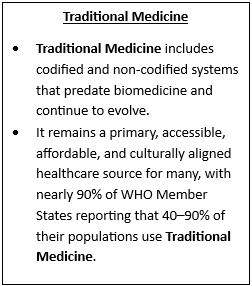
Key Developments in India’s Traditional Medicine
• India continues to expand international cooperation in the field of traditional medicine through education, research, and capacity building.
• The country provides 104 scholarships to foreign nationals, holds 26 MoUs, partners with 50+ global institutions, and has 15 Ayush Chairs and 43 Ayush Information Cells worldwide.
• Collaborative research initiatives, including Ashwagandha trials in the United Kingdom, Guduchi studies (Tinospora cordifolia) in Germany, and Ayurveda-based diabetes research in Latvia, are generating a growing body of evidence.
• Leveraging digital platforms such as the Ayush Grid and advanced technologies, including artificial intelligence.
• India is systematically documenting and validating traditional knowledge to address contemporary global health challenges.
• The 1st WHO Global Summit on traditional medicine was organised in Gandhinagar, Gujarat, in 2023.
• The World Health Organisation (WHO) Global Centre for Traditional Medicine (GCTM) was established in Jamnagar, Gujarat, India.
About WHO
• It was established in 1948 and is a specialised agency of the United Nations.
• The headquarters of the WHO is located in Geneva, Switzerland
• WHO connects nations, partners and people to work collectively on global health priorities.
• It is working with 194 Member Countries across 6 regions.
The most trusted learning platform on your phone
With our training programs, learning online can be a very exciting experience! Take the next step toward achieving your professional and personal objectives


NCERT Books
Resources
We love learning. Through our innovative solutions, we encourage ourselves, our teams, and our Students to grow. We welcome and look for diverse perspectives and opinions because they enhance our decisions. We strive to understand the big picture and how we contribute to the company’s objectives. We approach challenges with optimism and harness the power of teamwork to accomplish our goals. These aren’t just pretty words to post on the office wall. This is who we are. It’s how we work. And it’s how we approach every interaction with each other and our Students.
Come with an open mind, hungry to learn, and you’ll experience unmatched personal and professional growth, a world of different backgrounds and perspectives, and the freedom to be you—every day. We strive to build and sustain diverse teams and foster a culture of belonging. Creating an inclusive environment where every students feels welcome, appreciated, and heard gives us something to feel (really) good about.
Get Free academic Counseling & Course Details