logo

All Exams

Notifications

All Exams

Explore All Exams at KGS

All Exams
Home>Current Affairs>India-EU Free Trade Agreement
Current Affairs made simple.

Current Affairs provides you with the best compilation of the Daily Current Affairs taking place across the globe: National, International, Sports, Science and Technology, Banking, Economy, Agreement, Appointments, Ranks, and Report and General Studies

banner-image

India-EU Free Trade Agreement

SYLLABUS

GS-2: Bilateral, Regional and Global Groupings and Agreements involving India and/or affecting India’s interests.

GS-3: Indian Economy and issues relating to Planning, Mobilization of Resources, Growth, Development and Employment.

Context: India and the European Union (EU) announced the conclusion of negotiations for a Free Trade Agreement (FTA), an important milestone in one of India’s most strategic economic partnerships.

More on the news

  • According to Commerce Ministry officials, the language in the document will first be cleaned up over the next 10 to 15 days, following which it will undergo “legal scrubbing”. It will then have to be translated and sent to all 27 EU member states, before it can be ratified by the European Parliament. 
  • Alongside the ‘ambitious FTA’, India is also entering into a new India-EU Security and Defence Partnership and a system of mobility that would allow secure and legal movement of Indians to the EU region.
  • The two sides also welcomed the launch of talks on a ‘Security of Information Agreement’ to facilitate the exchange of classified information. 

Key highlights of the Agreement

•Timeline: 

  • 2007: India-EU FTA talks were first launched. 
  • 2013: suspended due to differences in market access for automobiles.
  • 2022: Resumed with both sides agreeing to exclude issues on which agreement had been elusive.
  • 2026: After almost two decades of negotiation, India and the European Union (EU) finalised a free trade agreement (FTA), billed as the “mother of all deals”.

• Drop in tariffs: 

  • EU drops tariffs on 99.5% of Indian exports.
  • India has given tariff concessions on 97.5% of imports from the EU, with European wines and luxury cars set to become less expensive.

• Gains for India: Tariff reductions across 97% of tariff lines, covering 99.5% of trade value. 

  • Of this, 90.7% of India’s exports will see duties eliminated entirely on the first day of the deal’s implementation, including labour-intensive sectors such as textiles, apparel, leather, footwear, tea, coffee, spices, sports goods, toys, gems and jewellery, and certain marine products, amongst others.
  • Another 2.9% of India’s exports will see duty elimination over three to five years. This would include certain marine products, processed food items, and arms and ammunition. 
  • Over and above this, 6% of India’s exports will see tariff reductions including certain poultry products, preserved vegetables, bakery products, amongst others.

• India’s offer to the European Union: India is offering 92.1% of its tariff lines which covers 97.5% of the EU exports, in particular:

  • 49.6% of tariff lines will have immediate duty elimination;
  • 39.5% of tariffs lines are subject to phased elimination over 5, 7, and 10 years’ 
  • 3% of products are under phased tariff reductions and few products are subject to TRQs for Apples, Pears, Peaches, Kiwi Fruit. 

• Duty elimination for India: The following sectors that India primarily exports to the EU, will see duties eliminated entirely:
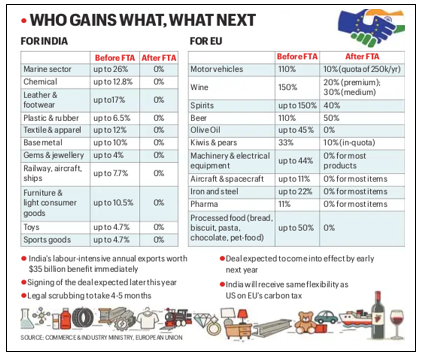
  • marine products (current duties of up to 26%), 
  • chemicals (12.8% currently), 
  • plastic and rubber items (6.5%), leather footwear (17%), 
  • textiles and apparel (12% each), 
  • base metals (10%), 
  • gems and jewellery (4%),
  • furniture and allied consumer goods (10.5%), 
  • toys and sports goods (4.7%). 
  • On Service Sector: The EU has agreed to commitments across 144 services sub-sectors, including IT/ITeS, professional services, education, and other business services.

• Quota-based systems: For few sectors such as automobiles and wine.

  • India agreed to allow European cars with a price tag above ₹25 lakh to be imported at lower duties of as low as 10%, from the current 110%, but subject to a quota.

• Exclusion for sensitive sectors:

  • India’s strategic agricultural and dairy sectors remain protected
  • EU will maintain its current tariffs on beef, sugar, rice, chicken meat, milk powder, honey, bananas, soft wheat, garlic, and ethanol.
  • No agreement on government procurement on Energy and raw materials.

• Limited agreement on the contentious Carbon Border Adjustment Mechanism (CBAM): The agreement creates a way for carbon footprint verifiers in India to gain accreditation. It also specifies that, should the EU give concessions under CBAM to a third country, those concessions would automatically apply to India too.

Significance of the Agreement

  • Geopolitical significance: The deal between two economies that together account for a third of global trade in the shadow of uncertainty sparked by the U.S. tariff regime.
  • ‘Largest-ever FTA’: This historic agreement will facilitate access to the European market for Indian farmers and small industries, create new opportunities in manufacturing, and strengthen cooperation in our services sectors.
  • Import Diversification: Imports of EU’s high technology goods are expected to diversify India’s import sources, thereby reducing input costs for businesses, benefit consumers and will create opportunities for Indian businesses to integrate into global supply chains.

About European Union (EU):

  • The European Union (EU) is a supranational political and economic union of 27 member states located primarily in Europe. 
  • Founded in 1993 with the Treaty of Maastricht (1992).
  • 19 of the 27 member states use the euro as their official currency.
  • The EU is India’s largest trading partner, accounting for trade in goods worth €120 billion in 2024, or 11.5% of India's total trade. 
  • India is the EU’s 9th largest trading partner, accounting for 2.4% of the EU’s total trade in goods in 2024, well behind the USA (17.3%), China (14.6%) or the UK (10.1%). 

footer image

The most trusted learning platform on your phone

With our training programs, learning online can be a very exciting experience! Take the next step toward achieving your professional and personal objectives


app-storeplay-store
logo
Khan Global Studies Pvt. Ltd. 5th Floor,
A13A, Graphix 1 Tower B, Sector 62,
Noida, Uttar Pradesh 201309

Course Related Query: [email protected] Store Related Query: [email protected]

Get Free Academic Counseling & Course Details

KGS best learning platform

About Khan Global Studies

We love learning. Through our innovative solutions, we encourage ourselves, our teams, and our Students to grow. We welcome and look for diverse perspectives and opinions because they enhance our decisions. We strive to understand the big picture and how we contribute to the company’s objectives. We approach challenges with optimism and harness the power of teamwork to accomplish our goals. These aren’t just pretty words to post on the office wall. This is who we are. It’s how we work. And it’s how we approach every interaction with each other and our Students.


What Makes Us Different

Come with an open mind, hungry to learn, and you’ll experience unmatched personal and professional growth, a world of different backgrounds and perspectives, and the freedom to be you—every day. We strive to build and sustain diverse teams and foster a culture of belonging. Creating an inclusive environment where every students feels welcome, appreciated, and heard gives us something to feel (really) good about.

Copyright 2026 KhanGlobalStudies

Have a question?

Get Free academic Counseling & Course Details

floatButton
India-EU Free Trade Agreement | Current Affairs