Current Affairs provides you with the best compilation of the Daily Current Affairs taking place across the globe: National, International, Sports, Science and Technology, Banking, Economy, Agreement, Appointments, Ranks, and Report and General Studies
News in Short
International Data Privacy Day
Context: Everyyear, Data Privacy Day is internationally observed on 28 January.
About International Data Privacy Day
It aims to raise awareness about the importance of protecting personal data and privacy in the digital age.
This year, the European Data Protection Board has set a strategic priority to keep children’s personal data safe online.
This day is also known as Data Protection Day, which was designated in 2006 by the Council of Europe to commemorate the signing of Convention 108.
Convention 108, officially called the “Convention for the Protection of Individuals with regard to Automatic Processing of Personal Data”, is the world’s first legally binding international treaty on data protection.
Data Privacy Day is a critical event in the digital era, emphasising the need to safeguard personal information and ensure data-handling procedures adhere to privacy and regulatory requirements.
It enables people to make more educated decisions about their data and pushes for improved privacy laws.
Data Privacy Week (January 26–30, 2026) is also celebrated as an international initiative to empower individuals and businesses to respect privacy, safeguard data, and build trust, with the theme “Take Control of Your Data.”
India’s Data Privacy & Security Readiness
Information Technology (IT) Act, 2000
The IT Act, 2000, is India’s core law for cyberspace, providing the legal basis for e-governance, digital commerce, and cybersecurity.
In alignment with the National Data Protection and Cybersecurity objectives, the Act grants legal recognition to electronic records and digital signatures, enabling secure online transactions and digital delivery of public services.
Digital Personal Data Protection Act, 2023
It governs the processing of personal data collected through digital means, including data digitised from offline sources.
The Act seeks to strike a careful balance between protecting individual privacy and enabling lawful data use to support innovation, service delivery, and economic growth.
TomTom Traffic Index 2025
Context: India is among the top-ranked most congested countries in the world according to the TomTom Traffic Index 2025.
More on the News:
Barranquilla, Colombia, and London, United Kingdom, topped the list.
India’s Traffic Congestion Profile
At the national level, India ranked as the 5thmost congested country globally and the second most congested in Asia, after the Philippines.
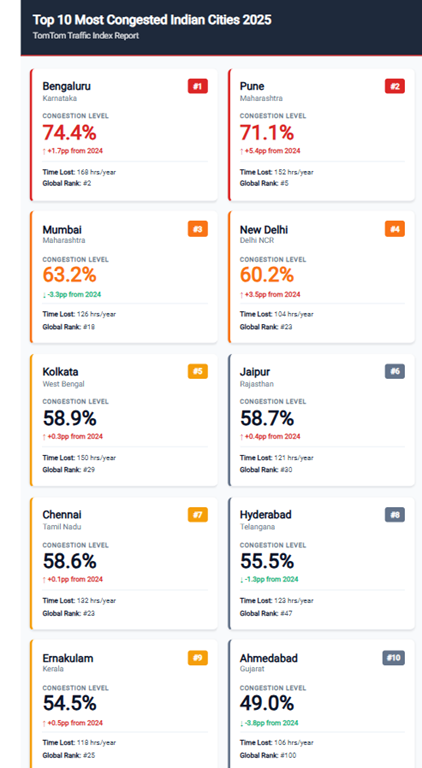
Bengaluru ranked third for slowest travel times, followed by Kolkata at fourth place.
Bengaluru:
Ranked 2nd among the world’s most congested cities in 2025, behind Mexico City.
Recorded an average congestion level of 74.4%, with peak-hour travel taking 15 minutes to cover 4.2 km at an average speed of 16.6 kmph.
Commuters lost an average of 168 hours annually to traffic, nearly a full working week.
Pune:
Ranked roughly 5th globally with a congestion level of 71.1%.
India’s second-worst city after Bengaluru.
Mumbai:
Ranked within the top 20 globally (63% congestion).
Shows slight improvement relative to the previous year.
TomTom data also indicated a broader shift in global commuting patterns in 2025.
Morning congestion (7–9 am) became more spread out, with lighter traffic early and extended late-morning flows.
Midday and early afternoon traffic (11 am–3 pm) increased, reflecting flexible work and hybrid schedules.
Evening congestion began earlier (from 3 pm) and lasted until 6 pm, leading to slower speeds despite a flatter peak.
About TomTom Traffic Index
It is built from anonymised GPS data and real driving speeds recorded across trillions of kilometres.
It enables detailed comparisons across countries and cities, offering trusted insights for cities, governments, organisations, and media outlets seeking to understand how mobility evolves and how to respond to it.
Data was anonymously collected from drivers within larger metropolitan areas (“metro”) and central city areas (“city”) throughout the complete road network, including fast roads and highways crossing these areas.
The 2025 index covers 500 cities in over 60 countries and is the most comprehensive edition yet.
Enhancing Circular Economy of ELVs in India Report
Context: A NITI Aayog report, “Enhancing Circular Economy of ELVs in India,” warns that the number of end-of-life vehicles (ELVs) in India could nearly double from about 23 million in 2025 to 50 million by 2030.
Key highlights of the Report:
Environmental Concerns: Older vehicles are substantially more polluting, with BS-I vehicles emitting up to eight times more than those meeting BS-VI standards.
Weak Scrap Management Structure:
Systems that are meant to test, scrap and recycle these vehicles are falling behind the scale of the challenge.
India’s current ELV scrapping system faces multiple challenges in establishing an effective and efficient scrapping ecosystem.
Key Challenges:
Limited availability of Automated Testing Stations (ATS), non-existent and underutilised Registered Vehicle Scrapping Facilities (RVSF) and complex procedural requirements for de-registration are underlined as key constraints.
An unregulated, informal scrapping sector, which operates at lower costs and offers attractive bids to vehicle owners.
Key Recommendations
Strengthen India’s scrappage ecosystem: Through coordinated infrastructure development, sector formalisation, simplified procedures, and awareness campaigns.
Infrastructure Expansion: Setting up of one ATS per district in states or union territories with a limited vehiclepopulation and no existing scrapping ecosystem. ATS and RVSFs to be established on a time-bound basis.
Public-Private Partnership: PSU-led models with private operations may be explored to ensure broader geographic coverage.
Formalisation of Sector: formalising the spare parts trade linked to ELVs, higher mandated recovery rates and transparency in value realisation.
Procedural Reforms: Vehicle de-registration should happen only upon submission of a valid certificate of deposit issued by RVSFs.
Information Dissemination: Make information on ATS and RVSFs widely available through transport offices and digital platforms.
About end-of-life vehicles (ELVs)
End-of-life vehicles are those that are no longer validly registered, declared unfit by an authorised automated fitness centre or road transport officer, and are voluntarily declared as waste by their legitimate registered owner.
Vehicle Scrappage Policy
Launched in 2021, the policy seeks to phase out old, polluting vehicles through ATS and RVSF.
Private vehicles over 20 years old and commercial vehicles over 15 years must pass fitness tests or be deregistered and scrapped.
The policy provides incentives, including scrap value, fee waivers, and tax rebates of up to 25% for non-transport and 15% for transport vehicles, to encourage voluntary scrapping.
With our training programs, learning online can be a very exciting experience! Take the next step toward achieving your professional and personal objectives
We love learning. Through our innovative solutions, we encourage ourselves, our teams, and our Students to grow. We welcome and look for diverse perspectives and opinions because they enhance our decisions. We strive to understand the big picture and how we contribute to the company’s objectives. We approach challenges with optimism and harness the power of teamwork to accomplish our goals. These aren’t just pretty words to post on the office wall. This is who we are. It’s how we work. And it’s how we approach every interaction with each other and our Students.
What Makes Us Different
Come with an open mind, hungry to learn, and you’ll experience unmatched personal and professional growth, a world of different backgrounds and perspectives, and the freedom to be you—every day. We strive to build and sustain diverse teams and foster a culture of belonging. Creating an inclusive environment where every students feels welcome, appreciated, and heard gives us something to feel (really) good about.