You're all caught up—no notifications available.
Explore All Exams at KGS


All Exams
Explore All Exams at KGS

Khan Sir Courses
Geography I Polity I History | World Map I Indian Map I Economics I Biology

UPSC & State PSC
UPSC I BPSC I UP-PSC I MP-PSC

State Exams
UP I Bihar I MP | Rajasthan

NEET | JEE | CUET
NEET | JEE | CUET

Defence Exams
NDA I CDS I CAPF I AFCAT I SSB I Agniveer

Police Exams
UP SI | Bihar SI | Delhi Police | UP Constable

SSC Exams
CGL I CPO I CHSL I MTS I SSC GD I Delhi Police

Foundation Courses
Physics I Chemistry I Biology I History I Geography I Polity I NCERT I Math I English | Map I Reasoning

Railway Exams
RRB | RPF

Teaching Exams
TET | Teaching | UGC

Banking Exams
SBI | RBI | IBPS

Engineering Exams
Civil | Electrical | Mechanical
UGC NET
UGC NET/JRF
Current Affairs provides you with the best compilation of the Daily Current Affairs taking place across the globe: National, International, Sports, Science and Technology, Banking, Economy, Agreement, Appointments, Ranks, and Report and General Studies

SYLLABUS
GS-3: Indian Economy and issues relating to planning, mobilization of resources, growth, development and employment; Inclusive growth and issues arising from it.
Context: The Reserve Bank of India cancelled the banking licence of Paytm Payments Bank Limited, under the Banking Regulation Act, 1949, citing serious regulatory and governance failures.
More on the News
• The RBI cancelled the licence under Section 22(4), prohibiting the bank from carrying out any banking activity under Sections 5(b) and 6 of the Act with immediate effect.
• The central bank will approach the High Court for winding up of the bank; however, it has clarified that the bank has sufficient liquidity to repay all depositors.
• The action was based on multiple violations, including:
• RBI had been tightening restrictions since March 2022 (ban on new customers), followed by 2024 restrictions prohibiting deposits, credits, and wallet top-ups due to persistent compliance failures.
• The move is largely procedural culmination, with minimal impact on parent company One 97 Communications Ltd, as it had already transitioned operations to partner banks.
About Payments Banks
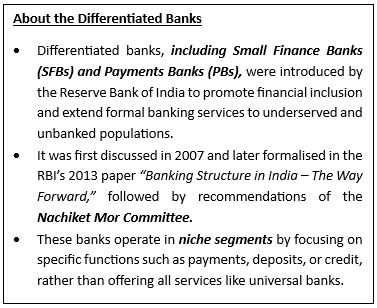
• A Payment Bank is a financial institution set up to operate on a smaller scale with minimal credit risk.
• It was introduced based on the recommendations of the Nachiket Mor Committee (2014) to promote financial inclusion by providing banking services to the unbanked and underbanked populations.
• Key Objectives:
• Regulatory Framework:
• Key Features of Payment Banks:
• Capital Requirements:
• Functions:
Payments Banks vs Commercial Banks
|
Feature |
Payments Banks |
Commercial Banks |
|
Max deposit limit: |
₹2 lakh per customer |
No cap |
|
Lending & credit: |
Not allowed (no loans, credit cards) |
Allowed (loans, credit cards,
overdraft) |
|
Product range: |
Basic: savings/current accounts, debit
cards, UPI, bill payments |
Comprehensive: FDs, RDs, loans, cards,
insurance, wealth products |
|
Capital requirement: |
₹100 crore minimum |
Typically ₹500 crore+ |
|
NRI/Time deposits: |
Not allowed |
Allowed |
|
Operational focus: |
Digital-first, small-ticket
transactions |
Full-service retail & corporate
banking |
|
Account accessibility: |
Zero-balance, instant onboarding |
Often requires minimum balance,
stricter KYC |
|
Deposit insurance (DICGC): |
Yes, up to ₹5 lakh (effectively covers
all deposits) |
Yes, up to ₹5 lakh per depositor |
The most trusted learning platform on your phone
With our training programs, learning online can be a very exciting experience! Take the next step toward achieving your professional and personal objectives



Course Related Query:
Ask Your DoubtsStore Related Query:[email protected]NCERT Books
Resources
We love learning. Through our innovative solutions, we encourage ourselves, our teams, and our Students to grow. We welcome and look for diverse perspectives and opinions because they enhance our decisions. We strive to understand the big picture and how we contribute to the company’s objectives. We approach challenges with optimism and harness the power of teamwork to accomplish our goals. These aren’t just pretty words to post on the office wall. This is who we are. It’s how we work. And it’s how we approach every interaction with each other and our Students.
Come with an open mind, hungry to learn, and you’ll experience unmatched personal and professional growth, a world of different backgrounds and perspectives, and the freedom to be you—every day. We strive to build and sustain diverse teams and foster a culture of belonging. Creating an inclusive environment where every students feels welcome, appreciated, and heard gives us something to feel (really) good about.
Get Free academic Counseling & Course Details