logo

All Exams

Notifications

All Exams

Explore All Exams at KGS

All Exams
Home>Current Affairs>India as a Global Leader in IRCCs under the Nagoya Protocol
Current Affairs made simple.

Current Affairs provides you with the best compilation of the Daily Current Affairs taking place across the globe: National, International, Sports, Science and Technology, Banking, Economy, Agreement, Appointments, Ranks, and Report and General Studies

banner-image

India as a Global Leader in IRCCs under the Nagoya Protocol

SYLLABUS

GS-3: Conservation, environmental pollution and degradation, environmental impact assessment.

Context: India has emerged as the global leader in issuing Internationally Recognized Certificates of Compliance (IRCCs) under the Nagoya Protocol, accounting for over 56% of all certificates issued worldwide.

More on the News
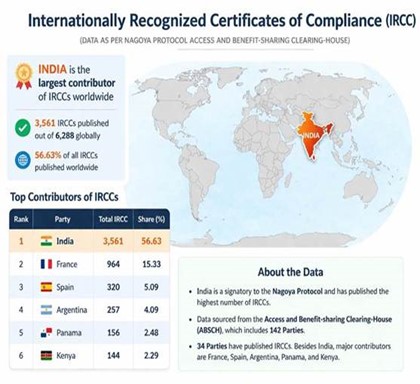
  • According to the latest data from the ABS Clearing-House, India has issued 3,561 IRCCs out of a global total of 6,311, placing it far ahead of all other countries in implementing the Access and Benefit-Sharing (ABS) framework.
  • Out of 142 countries registered on the ABS Clearing-House—a global platform promoting transparency and accountability—only 34 countries have issued IRCCs so far.
    o India is followed by France (964), Spain (320), Argentina (257), Panama (156), and Kenya (144).
  • India’s strong performance reflects the effective implementation of its ABS framework under the Biological Diversity Act, 2002, supported by a robust institutional structure:
    o National Biodiversity Authority (central level).
    o State Biodiversity Boards / UT Biodiversity Councils.
    o Biodiversity Management Committees (local level).

About Internationally Recognized Certificates of Compliance (IRCCs)

  • IRCCs are official certificates issued under the Nagoya Protocol as proof that access to genetic resources has been granted in accordance with international rules.
  • They certify that Prior Informed Consent (PIC) has been obtained and Mutually Agreed Terms (MAT) have been established.
  • Once issued, IRCCs are uploaded to the ABS Clearing-House, where they become globally accessible records.
  • Legally, a permit or its equivalent becomes an IRCC when it is issued by a competent national authority and published on the ABS Clearing-House.
  • Each IRCC contains key details such as the issuing authority and date, provider and user of the resource, genetic resource covered, confirmation of PIC and MAT, and the nature of use (commercial or non-commercial).
  • IRCCs act as a digital “legal passport” for genetic resources, enabling traceability across international borders and reducing risks of biopiracy.
  • Functional Role of IRCCs:
    o IRCCs help track the utilisation of genetic resources across the value chain from research to innovation and commercialisation.
    o They ensure transparency and accountability in access and benefit-sharing processes.
    o They monitor compliance with ABS regulations.
    o They facilitate fair and equitable benefit-sharing with provider countries.

About the Nagoya Protocol on Access and Benefit-sharing (ABS)

  • The Nagoya Protocol is a supplementary agreement to the Convention on Biological Diversity, adopted in 2010 at COP-10 and entering into force in 2014. 
  • Objective:
    o It aims to ensure the fair and equitable sharing of benefits arising from the utilisation of genetic resources.
    o It also contributes to biodiversity conservation and the sustainable use of its components. 
  • Scope: 
    o It covers genetic resources, including plants, animals, and microorganisms.
    o It includes traditional knowledge associated with genetic resources.
    o It applies to both research and commercial utilisation. 
  • Core Obligations:
    o Access obligations: Parties must establish clear procedures for Prior Informed Consent (PIC) and Mutually Agreed Terms (MAT), ensure legal certainty and transparency, and provide permits as evidence of access.
    o Benefit-sharing obligations: Parties must ensure fair and equitable sharing of benefits arising from utilisation, including monetary and non-monetary forms such as royalties, research results, and technology transfer.
    o Compliance obligations: Parties must ensure that genetic resources are accessed legally, monitor utilisation across value chains, and provide mechanisms for dispute resolution.
  • Institutional Mechanisms:
    o The ABS Clearing-House functions as an information-sharing platform.
    o National Focal Points (NFPs) and Competent National Authorities (CNAs) facilitate implementation at the national level.
    o Capacity-building and financial support are provided through mechanisms such as the Global Environment Facility.

Significance

  • Global Leadership & Model Implementation: India’s dominant share of IRCCs and the limited number of countries issuing them highlight its advanced implementation capacity, making it a global model in ABS governance. 
  • Institutional Strength & Decentralised Governance: The effective coordination between National Biodiversity Authority, State Boards, and local committees reflects cooperative federalism and strong institutional mechanisms.
  • Equity & Community Empowerment: Ensures fair benefit-sharing with local communities, farmers, and traditional knowledge holders, promoting inclusive and just resource governance. 
  • Transparency, Compliance & Legal Certainty: IRCCs create a traceable and accountable system for monitoring genetic resource utilisation across the value chain. 
  • Conservation–Development Linkage: By linking economic benefits with resource use, the framework incentivises biodiversity conservation, sustainable use, and bio-economy growth.

Sources:
News On Air
DD News
PIB
CBD

footer image

The most trusted learning platform on your phone

With our training programs, learning online can be a very exciting experience! Take the next step toward achieving your professional and personal objectives


app-storeplay-store
logo
Khan Global Studies Pvt. Ltd. 5th Floor,
A13A, Graphix 1 Tower B, Sector 62,
Noida, Uttar Pradesh 201309

Course Related Query:

Ask Your DoubtsStore Related Query:[email protected]

Get Free Academic Counseling & Course Details

KGS best learning platform

About Khan Global Studies

We love learning. Through our innovative solutions, we encourage ourselves, our teams, and our Students to grow. We welcome and look for diverse perspectives and opinions because they enhance our decisions. We strive to understand the big picture and how we contribute to the company’s objectives. We approach challenges with optimism and harness the power of teamwork to accomplish our goals. These aren’t just pretty words to post on the office wall. This is who we are. It’s how we work. And it’s how we approach every interaction with each other and our Students.


What Makes Us Different

Come with an open mind, hungry to learn, and you’ll experience unmatched personal and professional growth, a world of different backgrounds and perspectives, and the freedom to be you—every day. We strive to build and sustain diverse teams and foster a culture of belonging. Creating an inclusive environment where every students feels welcome, appreciated, and heard gives us something to feel (really) good about.

Copyright 2026 KhanGlobalStudies

Have a question?

Get Free academic Counseling & Course Details

floatButton